Don Quixote Rides Through a Starry Night: the tattoo I designed in 2021
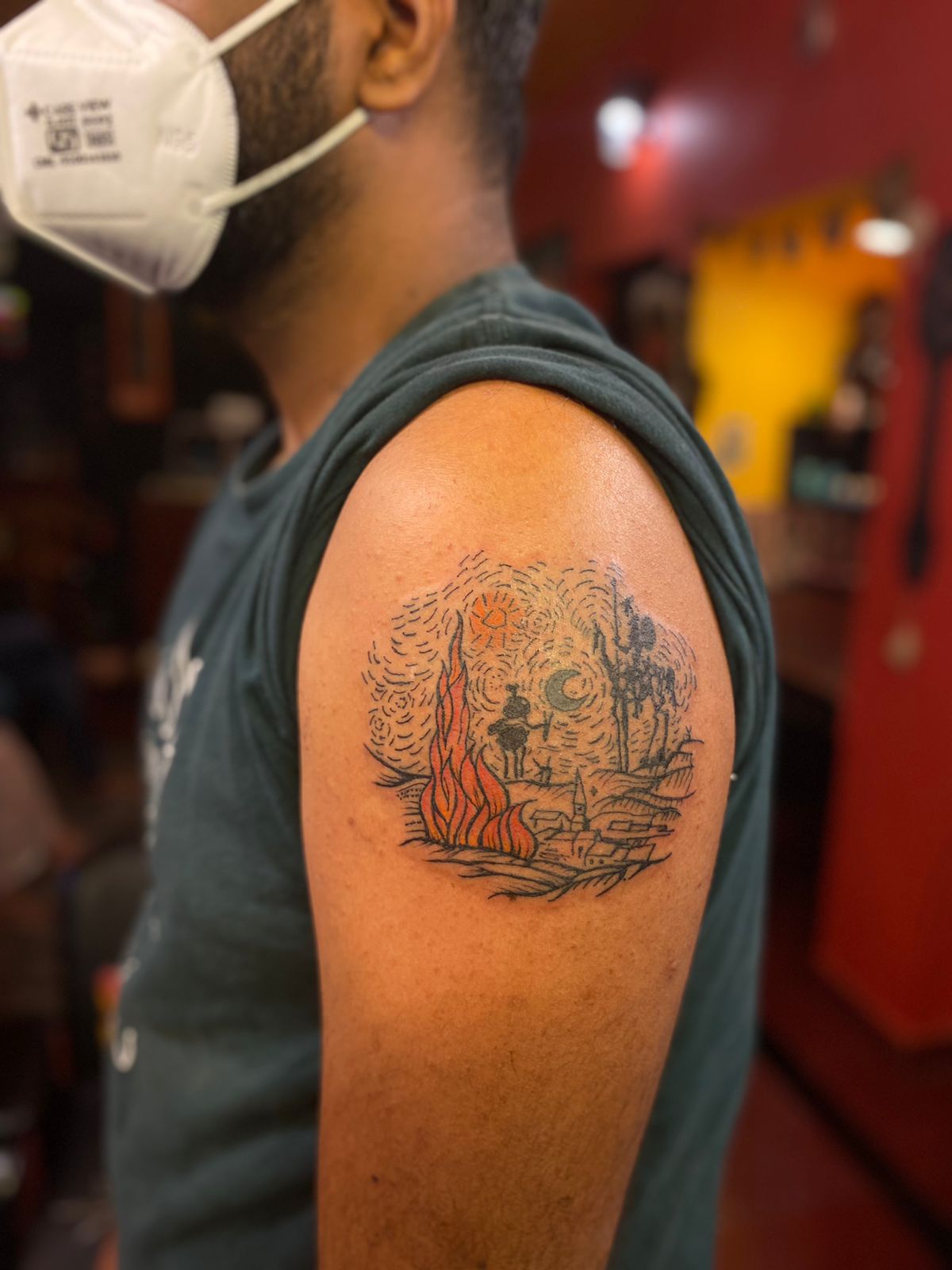
In 2021, during the strange quiet of the lockdown years, I got a tattoo that I had been designing in my head for a long time. It’s my own concept: a combination of my favourite book, my favourite piece of art, and a painting I have stared at more times than I can count.
Don Quixote, by Picasso. The Starry Night, by Van Gogh. One ink.
Where the idea came from
The book is Don Quixote, Cervantes’ story of a man who sees windmills and charges at them as giants. My favourite rendering of Quixote is not the book’s cover or a film still, it’s Picasso’s 1955 ink drawing: the thin, elegant line work of Don Quixote on horseback, Sancho Panza behind him, a single windmill on the horizon, and a sun hanging low in the sky. It’s one of the most economical drawings ever made. A few strokes carry an entire story.
The painting is The Starry Night, Van Gogh’s night sky of swirling blue, rolling like a current that the heavens can’t contain. It’s the closest art has ever come to drawing restlessness.
And at some point, quite separately, I asked myself: what would that windmill do if the sky behind it was alive?
The Quixote I grew up with
I related to Don Quixote long before I understood what a novel was. I was the oldest kid in the house, and a large part of my early childhood playtime was spent fighting imaginary wars with the hibiscus plants and plantains in our garden and backyard. The bushes were armies. The banana leaves were enemy lines. I charged at them the way Quixote charged at windmills, and nobody had to explain the metaphor to me.
Growing up, the connection only deepened. What I recognised in him as I got older was not the comedy but the identity crisis underneath it. There is a permanent tug of war between the realist and the imaginary personality inside me, and Quixote is the character who never pretended that tug of war was not real. He lived it out loud.
So the windmill was never just a design element for me. It was the first metaphor I ever lived, in a backyard full of hibiscus and plantain, years before I knew there was a name for it.
The Starry Night I fell into
If Quixote spoke to the tug of war between my inner realist and dreamer, the Starry Night spoke to the motion underneath all of it.
Van Gogh had a mind that could visualise the winds. He could see the uniformity in the wind, the stars, the moon, everything. The night sky is not a collection of separate things to him. It is one single current, moving together. The swirling band, the radiating stars, the rolling clouds, they are all part of the same flow.
The more I looked at it, the more I felt I was seeing the chaos inside a person. And that is the part that stopped me. Even though every person’s causes are different, at the end it is that same person, that uniformity, that is in turmoil. The sky looks turbulent, but it is one thing being turbulent. Not many things colliding. One whole mind, quietly falling apart and holding together at the same time.
That was the second half of the concept. Quixote gave me the dreamer who refuses to stop charging. Van Gogh gave me the storm that refuses to stop moving. And they are the same storm, seen from two different places.
The concept
Take Picasso’s Quixote, that spare and confident line, and set his windmill inside Van Gogh’s sky. Not the quiet sky of the drawing, but the Starry Night sky: the big swirling band, the radiating stars, the cypress-like flow that makes the whole canvas feel like it’s in motion.
Two dreamers colliding in one image:
- Quixote, the man who chose to see giants instead of windmills. A character written to be laughed at who ended up beloved. Proof that conviction outlives mockery.
- Van Gogh, the man who painted a sky more alive than the one above him, who saw the night as a force of nature instead of a quiet backdrop.
Both were dismissed as mad. Both turned out to be seeing something the rest of us needed help to notice. The tattoo is a quiet argument that the so-called madness of seeing more than what’s there is worth keeping.
The final piece
The photo speaks for itself, but here is the breakdown of what the ink actually holds.
The Starry Night elements
- The sky. The background uses dashed line-work to mimic Van Gogh’s famous impasto brushstrokes, creating the signature swirling wind currents.
- Celestial bodies. A bright blue crescent moon and a radiating orange star anchor the sky.
- The cypress tree. The large, flame-like structure on the left represents the cypress from the painting, coloured here in vibrant fiery reds and oranges instead of the original dark green.
- The village. The bottom edge features the quiet town of Saint-Rémy-de-Provence, complete with the distinct, pointed church steeple.
The Don Quixote elements
- The silhouettes. Squarely in the foreground are the unmistakable figures from Picasso’s 1955 sketch: the tall, lanky Don Quixote on his horse Rocinante wielding a lance, followed by his stout squire Sancho Panza on a donkey.
- The windmill. Just behind the figures sits a small windmill. Windmills are native to the Dutch landscapes Van Gogh painted, but here it serves as a direct reference to Don Quixote’s most famous delusion.
It sits where I can see it, and where the design’s two halves have room to breathe. Not hidden, not shouted about.
This ink, like most of my tattoos, came from Dreamcatcher Studio by Syama. She is one of the coolest people I have met. She sat with my concept, understood what the windmill and the sky meant to me, and captured all of it in ink. The tattoo is as much her hand as it is my idea.
Why 2021
The tattoo was partly a bookmark. I got it in a year where the world was small and still, and the inside of my head was anything but. A permanent reminder, drawn on during a temporary season: the windmills are never actually giants, but charging at them anyway is the whole point.
The takeaway
Designing this took longer than getting it. That’s the part I keep thinking about. I sat with the sketch for months, moved the elements around like a layout problem, and realised the interesting part of any concept is never the surface. It’s the collision: what happens to a drawing of a dreamer when you put him inside another dreamer’s dream.
That collision is probably the most honest thing I’ve ever had on my body.